Our Lady of the Rosary
- Voice of Saint Mary
- Jul 24, 2024
- 4 min read

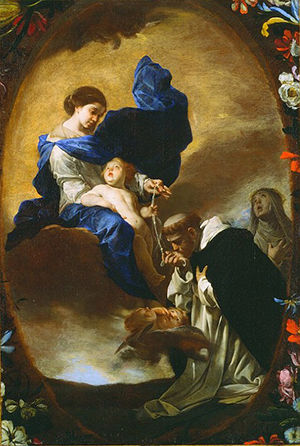
Our Lady of the Rosary (Latin: Beatae Mariae Virginis a Rosario), also known as Our Lady of the Holy Rosary, is a Marian title. Our Lady of the Rosary of Bullas
The Feast of Our Lady of the Rosary, formerly known as Feast of Our Lady of Victory and Feast of the Holy Rosary is celebrated on 7 October in the General Roman Calendar. 7 October is the anniversary of the decisive victory of the combined fleet of the Holy League of 1571 over the Ottoman navy at the Battle of Lepanto.
In the Western Rite Vicariate of the Antiochian Orthodox Church, the feast is celebrated on 7 October, under the title The Holy Rosary of the Blessed Virgin Mary.
According to Dominican tradition, in 1206, Dominic de Guzmán was at the Monastery of Our Lady of Prouille, in France, attempting to convert the Albigensians back to the Catholic faith. The young priest had little success until one day he received a vision of the Blessed Virgin, who gave him the rosary as a tool against heretics.
The story of Dominic's vision was fabricated by Alanus de Rupe and it was based on the imaginary testimony of writers that never existed. This traditional origin for the Rosary was generally accepted until the 15th century, when the Bollandists concluded that the account originated with Alanus, two hundred years after Dominic's death.

Background
In 1571, Pope Pius V organized a coalition of forces from Spain and smaller Christian kingdoms, republics and military orders, to rescue Christian outposts in Cyprus, particularly the Venetian outpost at Famagusta which, however, surrendered after a long siege on 1 August before the Christian forces set sail. On 7 October 1571, the Holy League, a coalition of southern European Catholic maritime states, sailed from Messina, Sicily, and met a powerful Ottoman fleet in the Battle of Lepanto. Knowing that the Christian forces were at a distinct material disadvantage, Pope Pius V called for all of Europe to pray the Rosary for victory, and led a rosary procession in Rome. Pius V instituted the feast of Our Lady of Victory in order to commemorate the victory at Lepanto, which he attributed to the Blessed Virgin Mary.
After about five hours of fighting on the northern edge of the Gulf of Corinth, off western Greece, the combined navies of the Papal States, Venice and Spain managed to stop the Ottoman navy, slowing the Ottoman advance to the west and denying them access to the Atlantic Ocean and the Americas.If the Ottomans had won, there was a real possibility that an invasion of Italy could have followed so that the Ottoman sultan, already claiming to be emperor of the Romans, would have been in possession of both New and Old Rome. Combined with the unfolding events in Morocco where the Sa'adids successfully spurned the Ottoman advances, it confined Turkish naval power to the eastern Mediterranean. Although the Ottoman Empire was able to build more ships, it never fully recovered from the loss of trained sailors and marines, and was never again the Mediterranean naval power it had become the century before when Constantinople fell.
In 1573, Pope Gregory XIII changed the name of the feast to Feast of the Holy Rosary, to be celebrated on the first Sunday of October. The Dominican friar Juan Lopez in his 1584 book on the rosary states that the feast of the rosary was offered "in memory and in perpetual gratitude of the miraculous victory that the Lord gave to his Christian people that day against the Turkish armada".
In 1671 the observance of this festival was extended by Clement X to the whole of Spain, and somewhat later Clement XI, after the victory over the Turks gained by Prince Eugene in the Battle of Petrovaradin on 5 August 1716 (the feast of Our Lady of the Snows), commanded the feast of the Rosary to be celebrated by the universal church.
Leo XIII raised the feast to the rank of a double of the second class and added to the Litany of Loreto the invocation "Queen of the Most Holy Rosary". On this feast, in every church in which the Rosary confraternity has been duly erected, a plenary indulgence toties quoties is granted upon certain conditions to all who visit therein the Rosary chapel or statue of Our Lady. This has been called the "Portiuncula" of the Rosary.
Pius X in 1913 changed the date to 7 October, as part of his effort to restore celebration of the liturgy of the Sundays. In 1960 under Pope John XXIII it is listed under the title Feast of the Blessed Virgin Mary of the Rosary; and under the 1969 liturgical reforms of Pope Paul VI Our Lady of the Rosary is mentioned as a mandatory memorial.
Here is a prayer from the early 20th century that asks the Virgin Mary to accompany us in our recitation of the rosary.
O Virgin Mary, grant that the recitation of thy Rosary may be for me each day, in the midst of my manifold duties, a bond of unity in my actions, a tribute of filial piety, a sweet refreshment, an encouragement to walk joyfully along the path of duty. Grant, above all, O Virgin Mary, that the study of thy fifteen mysteries may form in my soul, little by little, a luminous atmosphere, pure, strengthening, and fragrant, which may penetrate my understanding, my will, my heart, my memory, my imagination, my whole being. So shall I acquire the habit of praying while I work, without the aid of formal prayers, by interior acts of admiration and of supplication, or by aspirations of love. I ask this of thee, O Queen of the holy Rosary, through Saint Dominic, thy son of predilection, the renowned preacher of thy mysteries, and the faithful imitator of thy virtues. Amen.
Source : Aleteia , Wikipedia


Comments